Sliding Doors in the Home – A Complete Guide to Style, Space, and Smart Living

Sliding doors have become one of the most versatile and popular architectural features in modern home design. Whether used to divide interior rooms, connect living spaces to the garden, or replace bulky traditional doors in tight corridors, they offer a compelling combination of practicality and aesthetic appeal. Far from being a passing trend, sliding doors have a rich history — drawing on Japanese shoji screens and mid-century modernist design — and have evolved considerably with advances in materials, glazing technology, and sliding door hardware engineering.
Today’s homeowner is faced with an enormous range of options: from sleek aluminium-framed bi-folding doors that open an entire wall to the garden, to discreet pocket doors that vanish entirely into the wall cavity, to barn-style sliding panels that make a bold decorative statement. Each type comes with its own set of advantages, considerations, and maintenance requirements.
This guide explores all of these dimensions in detail, helping you make an informed decision about whether — and how — sliding doors might work in your home.
Types of Sliding Doors
Understanding the different categories of sliding door is the first step in choosing the right solution for your space. Each type operates differently and suits different settings.
1. Standard Sliding Doors
The most common variety, standard sliding doors consist of one or more panels that glide horizontally on a track, with one panel typically remaining fixed. They are a staple of patio and garden access points and are widely used in wardrobes and storage areas. They are simple to operate, relatively affordable, and available in a wide range of materials including UPVC, timber, and aluminium.
2. Bi-Fold Doors
Bi-fold doors feature a series of panels connected by hinges that fold back on themselves as they open, typically stacking neatly to one or both sides of the opening. They are particularly popular for creating a seamless transition between indoor living spaces and gardens or patios, and can span very large openings — sometimes the entire width of a room. When fully open, they create a genuinely open-plan feel that standard doors simply cannot achieve.
3. Pocket Doors
Pocket doors slide sideways into a cavity built within the wall itself, disappearing entirely when open. This makes them the ultimate space-saving solution, particularly in tight spaces like en-suites, home offices, or narrow hallways. They require more complex installation — ideally planned during a build or renovation — but deliver a beautifully uncluttered finish.
4. Barn-Style Sliding Doors
Inspired by traditional agricultural buildings, barn doors hang from an exposed overhead rail and slide along the face of the wall rather than into it. They have surged in popularity as a design-led interior feature, lending a rustic, industrial, or Scandi aesthetic depending on the material and finish. They are easier to retrofit than pocket doors but do require wall space beside the opening.
The Advantages of Sliding Doors
Sliding doors offer a wide range of benefits that explain their growing popularity in both new builds and renovation projects.
Space Efficiency
Perhaps the most cited reason for choosing sliding doors over hinged alternatives is the saving in floor space. A traditional hinged door requires a clear swing arc — typically around 0.7 to 0.9 square metres of floor area — that must remain unobstructed at all times.
In smaller rooms, hallways, or open-plan layouts, this can significantly limit furniture placement and traffic flow. Sliding doors eliminate this constraint entirely, allowing furniture to be positioned right up to the door frame.
Natural Light and Visual Flow
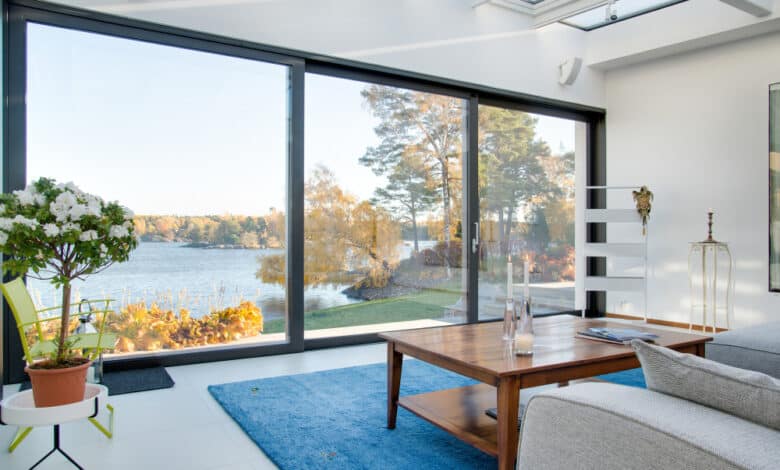
Large glazed sliding doors — particularly bi-folding or full-width patio doors — can dramatically increase the amount of natural light entering a room. Glass panels allow sunlight to penetrate deeper into the home, reducing the reliance on artificial lighting during daylight hours.
The visual connection to the garden or outdoor space also creates a sense of expanded space, making rooms feel larger and more open even when the doors are closed.
Flexible Living Spaces
Internal sliding doors offer an elegant solution to the demand for flexible living spaces. A pair of sliding panels between a kitchen and dining room, for instance, can keep cooking smells contained during meal preparation but be opened up for entertaining.
Similarly, a child’s bedroom or home office can be quietly separated from the living area without the visual or acoustic imposition of a solid wall.
Aesthetic Appeal
Modern sliding doors are available in a vast range of styles, finishes, and configurations, making it easy to find options that complement any interior design scheme.
Slim-profile aluminium frames in anthracite or black give a sharp contemporary look; solid timber panels with hand-forged hardware suggest warmth and craftsmanship; while frosted or reeded glass panels add privacy without sacrificing light. Used well, sliding doors can be a defining feature of a room rather than a mere functional element.
Accessibility
For wheelchair users, those with mobility difficulties, or anyone carrying bulky items, sliding doors are considerably easier to operate than hinged doors.
They require only a gentle lateral push or pull rather than the combined action of gripping a handle, stepping back, and pulling a heavy door towards oneself. This makes them a sensible choice in kitchens, utility rooms, and accessible bathrooms.
The Pitfalls and Drawbacks
Despite their many merits, sliding doors are not without drawbacks, and it is important to consider these carefully before committing to an installation.
Cost
Quality sliding doors — particularly large bi-folding or aluminium patio systems — represent a significant investment. While budget options exist, they often compromise on thermal performance, durability, or smooth operation.
A full-width bi-folding door system from a reputable manufacturer, professionally installed, can run into several thousands of pounds. Pocket doors, which require the construction or modification of a wall cavity, add further labour costs. It is important to factor in not just the purchase price but also installation, glazing, and any associated building work.
Sound Insulation
Sliding doors generally provide less sound insulation than a solid hinged door of equivalent quality. The sliding mechanism, by its nature, involves gaps — between panels, between the panel and the frame, and along the track — that allow more sound transmission than a tightly sealed hinged door.
While brush seals and compression gaskets have improved significantly, those seeking genuine acoustic privacy — for a home cinema, music room, or master bedroom — may find that hinged doors with proper weather seals remain the better option.
Security Concerns
Older or cheaper sliding door systems — particularly those on external patio doors — have historically been vulnerable to being lifted off their tracks or having their locks bypassed. Modern systems have largely addressed this with multi-point locking mechanisms, anti-lift blocks, and toughened or laminated glass.
However, it remains important to check the security credentials of any external sliding door carefully, particularly for ground-floor installations. Look for products that meet PAS 24 standards in the UK.
Track Accumulation
The floor track of a sliding door — particularly on external doors — can become a collection point for dirt, leaves, insects, and general debris. This not only makes the door harder to operate but can also cause premature wear to the rollers and seals. While top-hung systems (where the door hangs from an overhead rail rather than rolling along a floor track) mitigate this issue, they are not suitable for all door types or weights.
Limited Opening Width on Standard Sliders
A standard two-panel sliding door, where one panel is fixed, provides an opening of only half the total frame width. For a 2.4-metre wide door, this means a maximum opening of around 1.2 metres — perfectly adequate for pedestrian use, but potentially limiting for moving furniture or creating the fully open garden connection that bi-fold doors can achieve. This is worth considering when selecting door type and width.
Maximising Space with Sliding Doors
One of the most compelling reasons to choose sliding doors is their potential to transform the way a home feels and functions. Used strategically, they can make a small property feel significantly larger, or help a larger home adapt to changing needs. Here are the key ways to maximise this potential.
Replacing Internal Doors in Narrow Spaces
Narrow hallways, galley kitchens, and small bathrooms are among the most common casualties of traditional hinged door design.
Replacing a hinged door with a pocket door in a tight corridor can immediately open up the space, making it feel less cramped and allowing more practical use of the adjacent rooms. In a bathroom, the difference between a door that swings inward and one that disappears into the wall can be the difference between a functional and an impossible layout.
Creating Garden Rooms
In contemporary home design, the boundary between indoors and outdoors has become increasingly blurred, and bi-folding and sliding patio doors are at the heart of this shift. By replacing a traditional back wall with a full-width sliding system, a rear reception room can be transformed into an airy, light-filled space that effectively extends into the garden during warmer months.
The visual continuity between the internal floor and an outdoor patio — particularly when the same or complementary materials are used — further reinforces this expansive feeling.
Zone Control in Open-Plan Layouts
Open-plan living is widely admired, but it comes with its own challenges: noise, cooking smells, and the difficulty of heating or cooling a large undivided space efficiently.
Large internal sliding door panels — often floor-to-ceiling — offer a flexible compromise, allowing spaces to be opened up for entertaining and gatherings, then gently divided for quieter evenings or working from home. Glazed panels maintain the sense of visual connection even when closed, avoiding the claustrophobic effect of a solid partition.
Wardrobe and Storage Solutions
Fitted wardrobes with sliding fronts are a familiar and practical application of sliding door principles. They allow full-width access to storage without requiring any clearance in front, making them ideal for bedrooms where space is at a premium.
Modern systems can be configured with a huge range of panel materials — from mirrored glass that amplifies light and creates the illusion of a larger room, to lacquered MDF in any colour, to tactile woven fabrics.
Floor-to-Ceiling Installations
Installing sliding doors that run from floor to ceiling — rather than stopping at a standard door height — creates a strong architectural statement and a powerful sense of vertical space. This is particularly effective in rooms with higher ceilings, where a standard-height door can look oddly proportioned.
Floor-to-ceiling panels also require no bulkhead above the door, eliminating a visual interruption in the ceiling line and giving the impression of a taller, more generous space.
Maintenance: Keeping Sliding Doors in Top Condition
Like any moving mechanism in the home, sliding doors reward regular attention. A few simple maintenance habits will keep them operating smoothly, extend their lifespan significantly, and prevent minor issues from developing into costly repairs.
Track Cleaning
The track is the element most exposed to dirt, dust, and debris, and should be cleaned regularly — at least every few months, or more frequently for external doors. A stiff brush or an old toothbrush can be used to dislodge compacted dirt, followed by a wipe-down with a damp cloth.
Avoid using harsh chemical cleaners, which can degrade plastic or rubber components. For external tracks, a quarterly clean is a sensible minimum; more frequent attention will be needed during autumn when leaves and organic debris accumulate.
Roller and Wheel Inspection
The rollers or wheels on which the door travels are subject to gradual wear and should be inspected annually. Signs of wear include a grinding or scraping sensation when moving the door, a door that has started to drop or drag, or visible flat spots on the wheels.
Many systems allow rollers to be adjusted via a screw mechanism — often accessible from the bottom edge or side of the door panel — which can correct a door that has settled out of alignment. Replacement rollers are usually readily available and inexpensive, and fitting them early prevents damage to the track itself.
Lubrication
Periodic lubrication of the track and rollers keeps the door moving smoothly and quietly. The appropriate lubricant depends on the track material: for aluminium tracks, a silicone-based spray is generally recommended, as it does not attract dust or leave an oily residue.
For wooden tracks, a dry lubricant such as a wax candle rubbed along the surface works well. Avoid WD-40 on tracks, as it is a solvent rather than a true lubricant and can actually dry out and damage seals over time. Apply lubricant sparingly two or three times a year, or whenever the door begins to feel stiff.
Seal and Draught Strip Maintenance
The brush seals, rubber gaskets, and draught strips around sliding doors are essential for weather resistance, thermal efficiency, and noise reduction, but they degrade over time through UV exposure, compression, and general wear.
Inspect them annually for signs of splitting, flattening, or peeling, and replace them promptly when needed. Replacement seal strips are widely available and can usually be fitted without specialist tools. On external doors in particular, compromised seals can lead to water ingress, condensation within double-glazed units, and a significant increase in heat loss.
Glass Cleaning and Care
Glazed panels should be cleaned using a non-abrasive glass cleaner or a solution of warm water and a small amount of washing-up liquid, applied with a soft cloth or squeegee. Avoid abrasive pads or scouring agents, which can scratch glass surfaces and degrade any coatings, such as self-cleaning or low-emissivity (low-e) treatments.
Pay particular attention to the lower corners of panels, where water and dirt tend to collect. If condensation appears between the panes of a double-glazed unit, this indicates a failed seal and the unit will need to be replaced.
Frame Maintenance
Maintenance requirements for the frame vary depending on the material. Aluminium frames are low-maintenance and resistant to corrosion, requiring only occasional cleaning with soapy water. UPVC frames similarly need little attention beyond regular wiping.
Timber frames, by contrast, require more active care: they should be inspected annually for signs of paint or stain failure, and treated or repainted as necessary to prevent moisture ingress, which can cause swelling, warping, and eventual rot. Any cracks in the finish should be addressed promptly rather than left to worsen over winter.
Lock and Handle Maintenance
Handles and locking mechanisms should be checked periodically to ensure they operate freely and engage correctly. Apply a small amount of lubricant — graphite powder for locks, silicone spray for handles and hinges — if they become stiff.
Multi-point locking systems should be inspected to ensure all locking points engage properly; if any point fails to catch, the door may not be properly secured, and the mechanism should be adjusted or replaced. On external doors, it is also worth examining the security hardware annually, as this is both a safety and insurance consideration.
Conclusion
Sliding doors represent one of the most impactful upgrades available to the modern homeowner. At their best, they dissolve boundaries — between rooms, between inside and outside, between practical necessity and beautiful design. They liberate floor space, flood interiors with light, and offer the kind of flexible, adaptable living that suits the way people actually inhabit their homes today.
That said, they are not a universal solution. The upfront cost, potential acoustic limitations, and the demands of track maintenance are all real considerations that deserve honest assessment before installation. The right sliding door for a large, south-facing rear extension is unlikely to be the same product as the right solution for a narrow Victorian terrace hallway.
The key is to approach the decision with a clear understanding of what you need the door to achieve, a realistic budget that includes installation and associated work, and a commitment to the modest but important routine maintenance that will keep it performing well for decades to come. With those elements in place, a sliding door is not merely a fitting — it is a genuine enhancement to the quality and character of your home.